How to Track Initiative and Conditions Without Slowing the Session
By RollHoard . 6 min read . Updated June 2026
Combat is the most rules-intensive part of most tabletop RPG sessions, and the two things that slow it down most consistently are not knowing whose turn it is and forgetting which creature is affected by what condition. Both problems have simple, cheap physical solutions. A magnetic initiative board and a set of condition rings together solve probably 80 percent of the interruptions that stall combat rounds. This guide explains how to use them in combination, how to handle large encounters, and what to do when the system gets complex.
Quick answer
Set up the Paizo Combat Pad magnetic initiative board at the start of every combat round and update it in under two minutes. Pair it with Kraftex condition rings on every affected miniature so status effects stay visible across the table. Numbered creature markers distinguish identical enemies, eliminating the two most common combat stalls.
This guide contains affiliate links. RollHoard may earn a commission at no cost to you.
Setting up initiative in under two minutes
The Paizo Combat Pad Magnetic Initiative Tracker makes initiative setup fast because writing each combatant on a magnet and stacking them in order takes about 90 seconds for a standard encounter of 5 to 8 participants. Call initiative from all players simultaneously rather than sequentially. While players announce their rolls, write names and numbers. Order the magnets. Advance the current-turn arrow each round. The total overhead is under two minutes for the first round and near-zero for subsequent rounds.
The visible turn-order board changes player behavior positively. Players who can see they are two turns away start thinking about their action in advance rather than waiting to be prompted. The average time per player turn drops when players come to their turn with a plan rather than a question.
For DMs who prefer a screen-attached solution, the FableTop Magnetic Initiative Tracker Cards hang on the player-facing side of a metal screen and keep the order visible to everyone at once without requiring a separate board on the table. This works especially well when table real estate is limited.

Paizo Combat Pad Magnetic Initiative Tracker
A magnetic dry-erase board with 78 included magnets in four colors for player characters, enemies, and NPCs, the standard for physical initiative tracking.

FableTop Magnetic Initiative Tracker Cards
Magnetic dry-erase initiative cards that attach to any DM screen, keeping combat order visible to all players across the table.
Tracking conditions without confusion
Condition tracking fails at most tables not because DMs forget conditions exist, but because there is no physical indication on the creature that a condition applies. By round three of a complex encounter, a verbal-only condition log has degraded. A physical ring on the miniature base does not degrade. The Kraftex DND Condition Rings 96-Piece Set set addresses this with 96 rings across 24 conditions in labeled storage. Application takes three seconds per condition: pull the ring, slip it over the base.
The storage box matters as much as the rings themselves. A box with labeled compartments means you can grab the right ring in the dark of an intense combat moment without sorting through a pile. Keep the box at your left hand if you are right-handed. The workflow is: creature takes a condition, right hand writes or updates the initiative magnet, left hand pulls the ring and places it.
Remove rings the moment a condition ends and return them to the correct box slot immediately. Do not let spent rings accumulate loose on the table. A pile of unorganized rings at the end of a session creates setup friction for the next one.

Kraftex DND Condition Rings 96-Piece Set
96 acrylic condition rings across 24 conditions in a labeled storage box, fits standard 25mm miniature bases with clear condition text on each ring.

WildBot3D Condition Marker Rings 77-Piece Set
77-piece color-coded acrylic ring set for spell effects, magic hexes, and condition tracking, with bold high-contrast lettering visible across the table.
Handling large encounters with numbered markers
A combat with six goblins becomes exponentially more manageable when each goblin has a number. The CZYY Numbered Creature Markers 1 to 30 Set 1-to-30 set gives each creature in a group a unique identifier so hit points, conditions, and positions can be tracked individually. Goblin 3 took the rogue's arrow, goblin 3's ring gets the Poisoned condition, goblin 3's HP drops on the scratch sheet. No ambiguity.
Pair numbered markers with condition rings on the same creature. A numbered ring and a condition ring can both fit over a standard 25mm base simultaneously, or use two rings from different sets placed around the base edge. The numbers come from CZYY Numbered Creature Markers 1 to 30 Set, the conditions from Kraftex DND Condition Rings 96-Piece Set. Both are acrylic and the sizes are compatible.
For encounters with very large creatures where standard rings do not fit over the base, use disc tokens placed beside the model and label them with a dry-erase marker. The same numbered and condition system applies, just adjacent to the model rather than on it.

CZYY Numbered Creature Markers 1 to 30 Set
Acrylic rings numbered 1 through 30 for tracking individual creatures in groups, eliminates confusion when running multiple identical enemies.
Kraftex DND Condition Rings 96-Piece Set
96 acrylic condition rings across 24 conditions in a labeled storage box, fits standard 25mm miniature bases with clear condition text on each ring.
When to use AoE templates and how
Area-of-effect spells are the most common combat argument at tabletop. The ALIZERO Condition Rings and AoE Template Set kit includes acrylic templates for standard cone, line, and sphere effects that you physically place on the battle mat to show which grid squares fall within range. This is faster and less contentious than measuring with a ruler because the template is visually unambiguous.
Place AoE templates after declaring the spell and the point of origin, before resolving any damage. This sequence prevents post-hoc repositioning arguments. Leave the template in place during resolution so every player can verify which creatures were caught. Remove it immediately after damage resolves so it does not clutter the mat into the next turn.
For DMs who track this on the Chessex Reversible Battlemat (1-Inch Squares and Hexes), note that acrylic templates can slide on smooth vinyl. Hold the template in place with a light finger while verifying creature positions, then remove. Neoprene mats like the WizKids Deep Cuts Dungeon Tiles Neoprene Mat Set grip acrylic templates more securely.
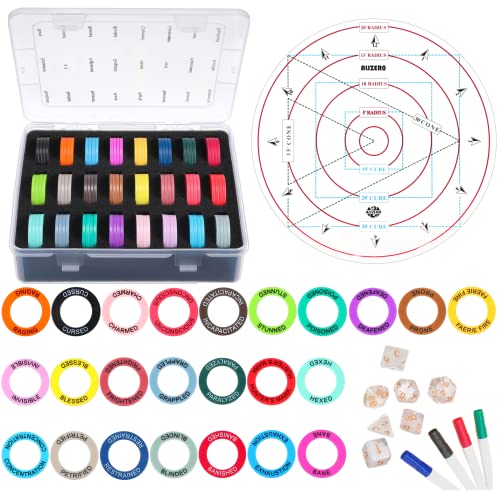
ALIZERO Condition Rings and AoE Template Set
96 condition rings in 24 statuses packaged with a set of acrylic area-of-effect damage templates for visualizing spell zones on the battle mat.

Chessex Reversible Battlemat (1-Inch Squares and Hexes)
The community standard 26 by 23.5 inch vinyl mat with 1-inch squares on one side and 1-inch hexes on the other, wet-erase surface.
Featured in this guide
Paizo Combat Pad Magnetic Initiative Tracker
A magnetic dry-erase board with 78 included magnets in four colors for player characters, enemies, and NPCs, the standard for physical initiative tracking.
Kraftex DND Condition Rings 96-Piece Set
96 acrylic condition rings across 24 conditions in a labeled storage box, fits standard 25mm miniature bases with clear condition text on each ring.
CZYY Numbered Creature Markers 1 to 30 Set
Acrylic rings numbered 1 through 30 for tracking individual creatures in groups, eliminates confusion when running multiple identical enemies.
FableTop Magnetic Initiative Tracker Cards
Magnetic dry-erase initiative cards that attach to any DM screen, keeping combat order visible to all players across the table.
ALIZERO Condition Rings and AoE Template Set
96 condition rings in 24 statuses packaged with a set of acrylic area-of-effect damage templates for visualizing spell zones on the battle mat.
Keep reading
Related roundups
FAQ
Frequently asked questions
What is the fastest way to call initiative at the start of combat?+
Ask all players to roll and call their total simultaneously rather than going around the table one by one. While they call out numbers, write each name and number on a separate initiative magnet or card. Order the magnets on the board and the setup is done. Sequential initiative calls, where you wait for each player to roll before moving to the next, take two to three times as long for the same information.
How do I track HP for 10 individual enemies without a spreadsheet?+
Use numbered creature markers paired with a simple paper HP scratch sheet. The numbers make each creature uniquely identifiable, and a column of names with tick marks for damage tracks HP without a digital tool. Many DMs find that grouping weaker enemies into pools, where any creature in the group shares the same HP pool, reduces the per-creature tracking burden significantly for larger fights.
Do condition rings work with theater-of-the-mind combat?+
Condition rings are designed for miniature-based play. For theater of the mind, condition tracking works best verbally or with a brief written list maintained by the DM. If you track conditions on a whiteboard, sticky notes on a piece of paper, or an index card per creature, the functional equivalent is a list system rather than physical rings. The rings solve the visual ambiguity problem that miniature-based play creates.